academic project
Autoparametric Resonance in a Spring-Pendulum System
A non-required group sixth-form project investigating energy exchange between pendulum-like and spring-mass motion in a spring pendulum.
Basic explanation
A mass on a spring can swing sideways like a pendulum and bounce vertically as the spring stretches. Under the right conditions those motions exchange energy periodically: one grows while the other fades, then the roles reverse. That transfer is called autoparametric resonance.
This was a non-required group academic project at the University of Liverpool Mathematics School, carried out with friends (Jude Bull, Taylor Richardson, and Dao Zhang). We chose the topic after finding an accessible demonstration online and wanting a feasible experiment that still forced us to derive conditions, collect data, and compare statistical models.
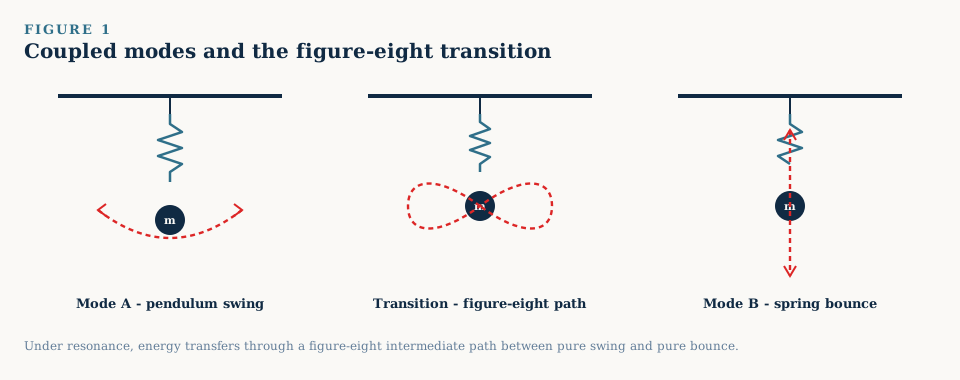
Schematic of pendulum swing, the figure-eight transition path, and vertical bounce under the derived resonance condition.
Resonance condition
Parametric resonance only appears when the periods of the two modes stand in a simple ratio. For the spring and pendulum to reinforce each other, the pendulum period should be twice the spring period :
Using Hooke’s law , the simple-pendulum period, and the mass-spring period, we derived the geometric constraint
where is the initial system length and the equilibrium extension. That relation recovers an offhand claim from the motivating demonstration and gave us a controllable experimental rule: vary mass , then set length from the formula while holding the spring constant fixed.
Experiment
We first measured by loading the spring in small increments and fitting against extension (obtaining roughly N/m). For the main runs we fastened the spring, attached a measured mass on an adjustable string, released from rest under the resonance condition, and filmed a stopwatch in frame. The dependent quantity was the period of a full energy-exchange cycle - time between successive maximum pendulum peaks - averaged over three repeats at each mass.
Statistical modelling
Polynomial regressions of orders zero through six were fitted to mass versus mean exchange period. Residual spread and chi-squared comparisons showed the largest meaningful improvement between quadratic and cubic models; within the tested range we therefore reported a cubic description of how attached mass relates to the period of autoparametric exchange, under the maintained resonance constraint.
What this shows
The project combined derivation, controlled experiment, and model selection rather than a single “correct” formula from a textbook. As a group effort it also required dividing experimental and analytical work while keeping the mathematical condition shared across every trial.